WHAT IS INSIDE43 units that turn knowledge into action
The live Serbian path contains 43 numbered units. They move from controlled first exchanges towards longer listening, grammar and independent responses.
- 10
Foundation · units 1–10
Use greetings, introductions, numbers, food and basic requests. By the end, you can introduce yourself, read both scripts, order food and ask where something is.
- 13
Expansion · units 11–23
Build present and past meaning, case choices and connected answers through picture cards, matching, listening checks and dictation.
- 20
Independent use · units 24–43
Work with longer audio, fuller sentences, role-play and guided production. The goal is to arrange plans, explain a problem and understand the answer in everyday Serbian.
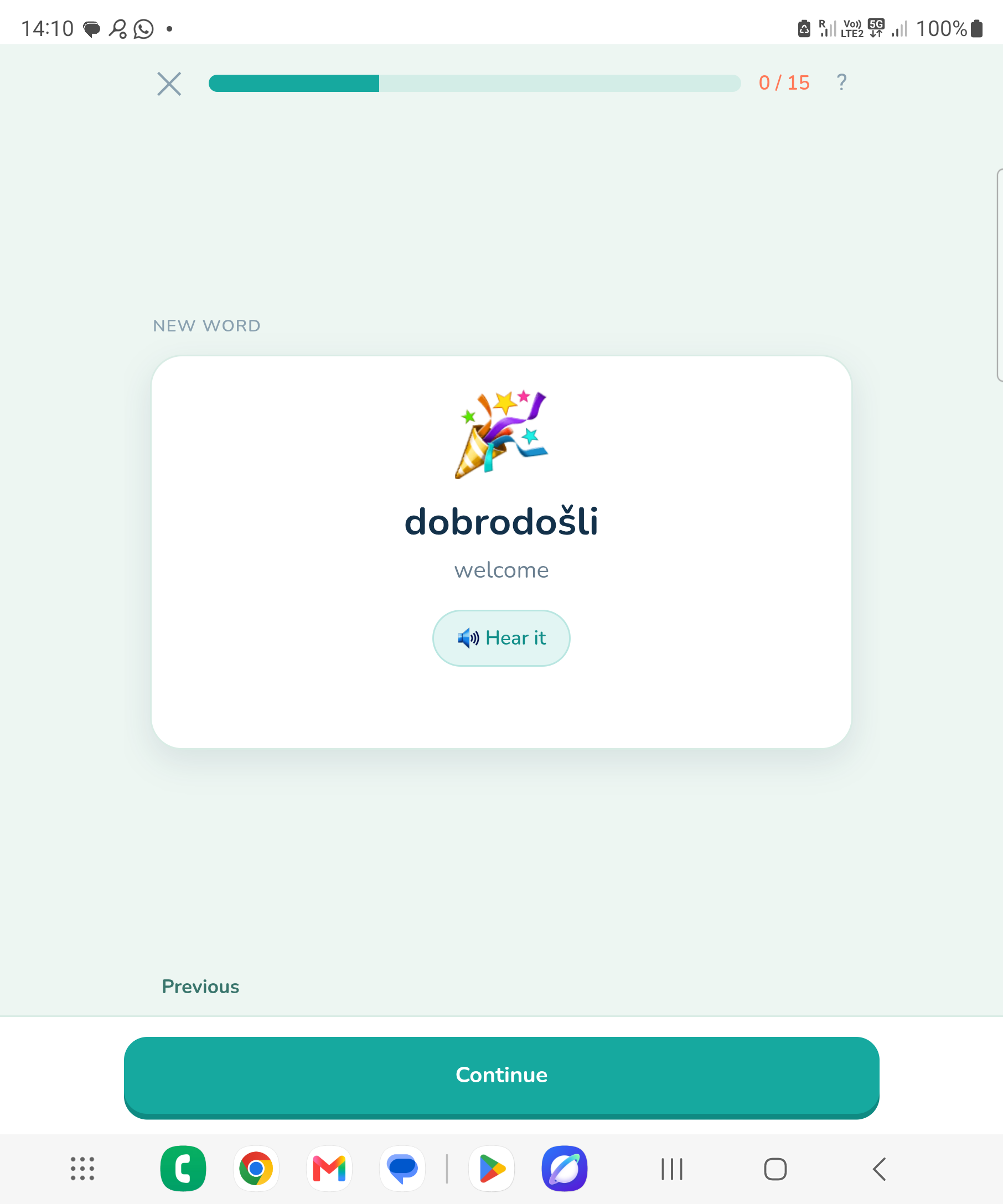
Lessons mix native recordings, picture recognition, sentence building, multiple choice, dictation, say-it prompts and spaced review. The format changes often enough to test listening, reading, memory and speech rather than rewarding one repeated gesture.
What you practise in the Serbian path
Early lessons centre on real introductions, simple questions, food, numbers and finding your way. Both Latin and Cyrillic appear so a learner can connect one spoken word with either written form. The course does not demand an alphabet detour before communication; script recognition grows alongside useful sentences.
The middle of the path brings verbs, agreement and case choices into practical situations such as shopping, travel, home and work. A learner hears the target, selects or builds the answer, and then meets it again through dictation or spoken production. Explanations identify the job an ending performs instead of presenting a bare correction.
In the later units, prompts become longer and less predictable. You work with accounts of past events, arrangements, opinions and service conversations. Review pulls earlier vocabulary into new sentences, so progress is measured by whether you can retrieve and adapt language. The endpoint is practical Serbian you can use to organise plans, state a problem and understand the response.
Focused grammar practice sits beside the main path. It lets learners revisit a difficult form while their numbered journey continues to supply the context, audio and repeated production needed to make that form usable.